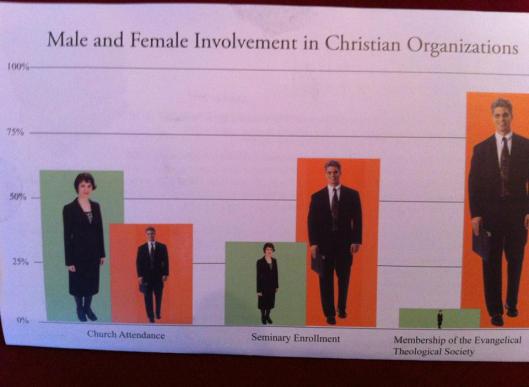
ETS is rather broad in spectrum rather than monolithic on the gender issue
12 Saturday Nov 2011
Posted in Academics, Biblical Studies, Feminist Theory, Gender Studies
12 Saturday Nov 2011
Posted in Academics, Biblical Studies, Feminist Theory, Gender Studies
10 Thursday Nov 2011
Posted in Academics, Feminist Theory, Gender Studies, Religion
Tags
AAR, American Academy of Religion, ETS, Evangelical Theological Society, SBL, Society of Biblical Literature
Further to discussions about the low number of women presenting at the Society of Biblical Literature (SBL) conference, and the disgustingly low number of women presenting at the Evangelical Theological Society (ETS) conference in 2011 – what are the comparative figures for the American Academy of Religion (AAR) conference this year?
The names for the first 200 abstracts include 119 male and 81 female presenters.
So based on the samples carried out, the percentages of women presenting at the three largest annual religious studies conferences are:
American Academy of Religion (AAR): 41%
Society of Biblical Literature (SBL): 29%
Evangelical Theological Society (ETS): 1%
08 Tuesday Nov 2011
Posted in Academics, Biblical Studies, Feminist Theory, Gender Studies
Tags
Buffy the Vampire Slayer, ETS, Evangelical Theological Society, Michael Bird, SBL, Society of Biblical Literature, women
Michael F. Bird (Evangelion) notes that, of 700 papers to be presented at this month’s Evangelical Theological Society Conference, he recognises that only 8 are by women. There may be a few other women’s names that Michael acknowledges he does not recognise, but let’s not quibble over details. That’s 1%!
How does the Society of Biblical Literature Annual Meeting compare? Taking as a sample the first two pages of the Participant List, I get 40/137 on page one and 40/137 on page two. That’s 29%.
In most disciplines, that’s just below the percentage of women who are members of the faculty – and this with the inclusion of up-and-coming female students.
Why? Given the dominance of Christians at SBL, and the dominance of males in positions of authority within Christianity, is the percentage of women presenters a product of this demographic?
(And on a related issue: why is the local U.S. meeting considered the annual meeting of a purported global body, and not the international meeting?)
I prescribe a large dose of Buffy the Vampire Slayer for all attendees at ETS and SBL this year:
30 Sunday Oct 2011
Posted in Capital, Feminist Theory, Film, Gender Studies, History, justice, Language, News, Politics, Rationalization, Religion, Rhetoric, Texts, Theory, Transhumanism, Violence
In the hours leading up All Hallow’s Even, I have a few recommendations for anyone looking to curl up with a truly frightening film tomorrow night. In no particular order, here we have two really scary recent films to keep you up all night …
Sucker Punch (Zack Snyder, 2010): What is most horrifying about this film is the what it suggests about the utter bankruptcy of a postmodern imagination rooted in reference and remix rather than in telling stories. Zack Snyder’s slickly pretty parable about a nubile young woman, Babydoll (a hyper-sexualised Emily Browning), who creates elaborate fantasy worlds to escape the appalling conditions of the 1960s-era mental hospital in which she is imprisoned is truly chilling, though it was intended to be a story of the empowering potential of the imagination. The film unintentionally pulls back the curtain on the hollowness of genre filmmaking uncoupled from any sense of history or any awareness of the real world of flesh-and-blood human beings. 
Snyder, a visual stylist of the first order, has repeatedly shown in his adaptations of other people’s work that he can unearth the dark heart of a text but lacks either the talent or the intelligence (or both) to do anything with its subtext. In his solid, scary, but completely unnecessary remake of George A. Romero’s 1978 zombie horror masterpiece, Dawn of the Dead, Snyder evacuates the film’s setting, a suburban shopping mall, of all of its social criticism and its larger meaning. It becomes a backdrop for the film’s action, not part of its story. Romero made pointed criticisms of consumer capitalist culture by comparing the drooling hordes of zombies with shoppers in a mall, a sad, poignant, and utterly damning portrayal of normality as a world of the living dead. In his adaptation of Frank Miller’s 300, Synder captures all of Miller’s unfortunate fascistic tendencies but does nothing but make them live, breath, and bleed in visceral slow-motion. With Watchmen, adapted from Allan Moore and Dave Gibbons’ epoch-making alternative history comic book series (1986 -1987), Snyder faithfully captures and even amplifies the profound ugliness of Moore’s New York, but, unlike Moore (who has quite rightly disavowed the film), Snyder simply maroons us in this morass of grime and neo-noir pastiche. Moore turned the tale of ordinary people playing at superheroes into a potent and cutting critique of 1980s excess as the flipside of 1960s idealism. Synder just lets the ugliness speak for itself. Robbed of its context, not surprisingly, it has nothing to say.
Sucker Punch performs a similar trick, but this time it is even worse. Synder, working from his own script for the first time, gives us an utterly self-insulated and self-referential world; when Babydoll creates a series of elaborate fantasy worlds as a way to escape the very real horror of her situation, Synder is unable to give her anything to work with outside of noise and furious action (some of it, admittedly, staged quite beautifully). She imagines first a burlesque club as a stable first layer of fantasy and then a sequence of other, more fantastical secondary levels of disassociation, featuring giant samurai robots, zombie soldiers, dragons, and futuristic trains guarded by faceless automatons. In other words, the worlds that Babydoll creates in the 1960s are a pastiche of films, television shows, and comic books that she cannot have seen, given that they all appear on the cultural scene considerably later. What can we make of this? Is Snyder saying that all fan-boy culture is the creation of disturbed minds that create elaborate alternative worlds as a way of dealing with – or not dealing with – the cruel, senseless, and violent world outside the mind? It would be comforting to believe this, but, given that the film is itself masturbatory genre-fan pornography, a melding of the extreme sexualisation of young women in Japanese manga with the spectacle of contemporary fantasy film and the dense visual dazzle of big-budget science fiction cinema (though without any of the ideas that make films like Blade Runner, Children of Men, The Day the Earth Stood Still, and Sector 9 so memorable), it is difficult to give the film this much credit.
Synder’s world, then, is just another layer of unreality, and the audience is trapped in revolving worlds of noisy, hollow fantasy, just as Babydoll is. This is Debord’s nightmare of the spectacle taken to its horrific logical end. Worse than this, there is a moral hole at the very centre of Sucker Punch that is truly appalling, especially given that its director and many of its cast members have painted it as a feminist work. Most viewers do not have to escape from anything as bad as Babydoll does. In the film’s single scariest moment, Synder takes us into a filthy room with a solitary mattress on the floor and reveals the the hospital is witness to the serial rape of its young female inmates at the hands of a slovenly orderly. That Synder takes the silly, superficial Sucker Punch to levels of human depravity as dark and despicable as this is truly horrifying.
Margin Call (J. C. Chandor, 2011): This one is a bit unfair, I must admit, given that I am performing the lazy, reactionary critic’s move of writing about a film I’ve not actually seen (see almost any orthodox Christian critique of Martin Scorcese’s brilliant The Last Temptation of Christ for an example). I can only ask you to cut me some slack; I live in Dunedin, where mid-level films like this arrive rather later than for most, if we get to see them at the cinema at all. This criticism is not so much about the film, in any event, but the larger discursive structure that surrounds it. Judging by the beautifully-cut trailer for the financial thriller Margin Call, the true horror is that, faced with another in a long line of financial crises, we are still being sold the myth that such crises are surprising, that they are the work of a few unscrupulous people working dishonestly, that they are preventable. As the slovenly rockstar philosopher and recent al-Jazeera correspondent Slavoj Žižek writes in his incisive First as Tragedy, Then as Farce (London: Verso, 2009):
The only truly surprising thing about the 2008 financial meltdown is how easily the idea was accepted that its happening was an unpredictable surprise which hit the markets out of the blue. (p. 9)
For anyone in the know, this crisis, an inevitable result of a system that is based on exploitation and the faultiest of logic, was not a surprise. Its collapse is not the work of a few (though many of the people in charge are indeed rather despicable), but the result of attempting to create a necessary and infinite growth in a material and human field of finite resources. In short, the system fails because it has to, because it cannot not fail. That this mythology (and this is myth in the formal sense of the word as well as in its more commonplace pejorative sense) is still being repackaged and foisted upon as entertainment is something that will keep me up all night.
And now for two recommendations for those of you interested in actual horror films …
The Changeling (Peter Medak, 1980): This film, which I first saw with my older brother when I was about twelve, still scares the pants off of me. The infinitely sad, haunting, and edge-of-your-seat tense story of a grieving widower (played by the great George C. Scott) who moves into a giant old house to try to put his life back together after the death of his family, this is one for those of you who think that the spooky séance scene cannot be scary after being done so many times. There are images in this film (the well, the well!) that can give me the chills just sitting here typing this.
Take Shelter (Jeff Nichols, 2011): After their quietly devastating collaboration on Shotgun Stories (2007), director Nichols and lead Michael Shannon (so good as a disturbed evangelical Christian in Boardwalk Empire) reunite for this chilling and infinitely unsettling story of a man haunted by visions of a coming apocalyptic storm. This one sets out to shake you and does it with infinite care and control rather than with jump-scares or people in silly masks. This is the psychological thriller as existential horror film, an interrogation of the idea of sanity in a world that is seemingly spiralling ever closer to irrevocable madness that is on par with Lars von Trier’s Melanchlia, which asks similar questions, though in a far more global and economic context (see more on that here) than Take Shelter‘s intimate portrait of the disintegration of a single Midwestern American family. The last fifteen seconds of Take Shelter are scarier and more deeply disquieting than any ten recent horror-classic remakes or anything in the thousands of pages of the Twilight Saga.
Sleep well, my friends …
13 Wednesday Jan 2010
Posted in Gender Studies, Hebrew Bible, Queer
Tags
Anne Sexton, Charles Renouvier, Chronicles, cock, Joseph Gelfer, Journal of Men, Masculinities and Spirituality, phallus, Roland Boer, temple, The Fury of Cocks, Uchronia
Thanks to Roland Boer, who introduces me to this term: Uchronia (think u-topia, but in terms of time, not place: Merry Arthurian England, The Early Church, Solomonic Enlightenment, Primitive Communism, post-Revolution but pre-Terror, etc, etc…). Apparently, according to one fairly reliable source, “It was coined by Charles Renouvier as the title of his 1876 novel Uchronie (L’Utopie dans l’histoire). Esquisse historique apocryphe du développement de la civilisation européenne tel qu’il n’a pas été, tel qu’il aurait pu être.“
“Uchronia” has great applicability in the study of the Hebrew Bible, and Dr Boer makes use of it in “Of Fine Wine, Incense and Spices: The Unstable Masculine Hegemony of the Books of Chronicles,” Journal of Men, Masculinities and Spirituality 4.1 (2010): 19-31 (that is, in Australian-based Joseph Gelfer’s spectacularly successful journal).
At the (spatial) centre of Chronicles’ uchronic vision stands “the priapic temple” itself:
“It is a massive phallic tower, a high-rise temple for Solomon, like some angular cock raised to the heavens with its balls on the ground. Commentators on Chronicles are keen to cut down this phallus: the unanimous agreement is that 2 Chronicles 3.4a is—of course!—corrupt. It could not possibly mean a massive tower of 120 cubits. However, I suggest that this text is a telltale sign of the text’s masculine economy, for it is the image par excellence of the overwhelming if desperate effort to assert a male-only world.”
But flaccidity accompanies this “stiff” male hegemony. Have a read. It’s historical criticism at its finest. And read Anne Sexton, who also understood the limits of cock-temple power:
The Fury Of Cocks
There they are
drooping over the breakfast plates,
angel-like,
folding in their sad wing,
animal sad,
and only the night before
there they were
playing the banjo.
Once more the day’s light comes
with its immense sun,
its mother trucks,
its engines of amputation.
Whereas last night
the cock knew its way home,
as stiff as a hammer,
battering in with all
its awful power.
That theater.
Today it is tender,
a small bird,
as soft as a baby’s hand.
She is the house.
He is the steeple.
When they fuck they are God.
When they break away they are God.
When they snore they are God.
In the morning they butter the toast.
They don’t say much.
They are still God.
All the cocks of the world are God,
blooming, blooming, blooming
into the sweet blood of woman.
27 Sunday Sep 2009
Posted in Biblical Studies, Feminist Theory, Gender Studies, God
Tim Bulkeley, Old Testament lecturer at Carey Baptist College, Auckland is writing a book. And utilising the easy interactivity of the internet, he is writing it with you. Yes, you can have your say, and it could very well change the shape of the book.
And if it does, I guess you can claim co-authorship credit on your C.V.
The topic is “motherly talk of God from the Bible, and from great Christian theologians from the past.” And the book’s title is, currently, Not Only a Father: Motherly God-language in the Bible and Christian Tradition – although that may well change over time. In order to read the book as it currently stands and to make comments, or engage in discussion with others, have a look at the digress.it website.
Here’s the suave-looking Tim himself:

09 Sunday Aug 2009
Posted in Children's rights, Feminist Theory, Gender Studies, Living, Queer
Tags
On a slightly different note to Deane’s posting on the Referendum(b), it seems to me that underlying a lot of the arguments in this debate – in general, not necessarily on his post – is the fear by some that “the family” is being undermined … That certain people feel that this “smacking issue” is just one more way in which their (oft-called Christian) model of family is being “attacked” – not a lot dissimilar to the anxiety the same groups express that if gays are allowed to marry then somehow that will mean “the family” (ie. Christian, white, middle class, nuclear, capitalist etc.) will be threatened ..
(Just type family, slippery slope, gay marriage etc into Google …)
Somehow gay/lesbian families, or straight families which have a more egalitarian view of children/adult and male/female “roles” threaten what are seen as “traditional” families (with their “traditional family values”) … The “rise” of this egalitarian-style of family is seen as a direct (and deliberate) challenge to the traditional-style. But why is this?
I think that is a stone worth peering under – what nasty things are crawling around under there??
My suspicion is that underneath this anxiety lies the fear that what will really be lost is the authority of the father – the patriarchal right to discipline, to be the head of his home, to be THE authoritative figure in perhaps one of the few remaining places where he can be assured of this status …
And for some of these people, this of course equates with the loss of authority of the God-Father figure – once that has been “undermined” then all chaos breaks out (supposedly). And for the State to be a party to this emasculating of both men/fathers/God, then no wonder the debate is fierce!!!

04 Tuesday Aug 2009
Posted in Feminist Theory, Gender Studies, Theology
Tags
So I am in this amazing study, right, and it’s just lined with books. I am running my fingers along the spines, not even looking at the titles really – it’s the overall feel of them that tells you all you need to know. And he is sitting just over there, in that leather armchair, barely visible through the smoke. I don’t mind the smoke – it’s from a pipe, or a cigar maybe, take your pick. He’s got that look in his eye, I just know it – you know the one – a smoldering sparkle just ready to burst into flame. I can tell even if I am not looking at him. I pretend to look at the books.
But sooner or later we are going to have to talk and it will be me that has to say something, we both know this. Why would he say anything? He is the one all comfortable in that chair. All smug with the world revolving around his finger. The weight of the room tells me this, the feel of all those spines tells me this. Even the smoke tells me, intoxicating me with its sweet strength. I am the one who is light, who barely leaves a mark on the thick carpet as I circle the room. I am the one who might bend or break. He knows this, is sure of this, and so can just watch through the smoke as I let my hand caress those spines.

My circling has taken me to the dark corner behind his chair. And although the leather back of it is high and its arms curve wide to embrace him, I reach around and take the pipe (although I think it’s a cigar) from his mouth. He likes this. He thinks it’s a game. It’s not just his eyes that are sparkling now. This is a game he likes to play, has played before, and wins every time. Why talk when you can play this game? But I don’t want to play this little game anymore. There are rules I want to bend and break.
So instead of straddling his lap, and replacing the pipe (it’s definitely a cigar) with my lips, and letting him win, I walk over to the other armchair in the room (they are a pair), and I make myself comfortable with one leg draped over the side, and I take a long deep pull on that pipe-that-is-a-cigar and after exhaling that sweet strong smoke I say, “Karl, we need to talk.”